
You run meetings. You pay your own bills. You’ve built a life you’re proud of. Then you walk into your mother’s kitchen, someone asks why you’re still not married, or still in that job, or still not eating meat, and in four seconds flat you’re fourteen again, slipping back into a role you outgrew years ago.
That’s not you failing at being a grown-up. That’s a nervous system walking back into the room where it learned its oldest patterns. The smells, the voices, the seating chart: they all whisper, remember who you used to be here?
This post won’t fix your family. It’s about something smaller and more doable: staying yourself at the table, and leaving with your evening, and your peace, still in one piece.
Why family gatherings hit differently
Three things stack up at once.
The roles are old. Families run on parts we were cast in years ago: the responsible one, the funny one, the one who always starts it. Walk back in and everyone, including you, starts reading from the old script.
The body is already tired. Travel, short days, a year-end crunch at work, and a kitchen at full heat. You arrive with less in the tank than you think.
And the stakes feel high. It’s one day a year, everyone wants it to go well, and that pressure makes every small comment land harder.
None of that is a character flaw. It’s a lot of load at once. Which means the answer isn’t trying harder to be patient. It’s a few small skills, practiced before you need them.
6 ways to stay calm at holiday family gatherings
1. Decide your “if-then” before you arrive
You already know the moment. The question about your weight. The political aside over the green beans. Instead of hoping it won’t come, plan for it. Research on “implementation intentions,” simple if-then plans, found across 94 studies that people who decide in advance when and how they’ll act follow through far more often than people who only set the goal (Gollwitzer & Sheeran, 2006). Most of that research is about goals like exercise and studying, not family dinners, but the logic carries.
Try this: write one line in your phone on the drive over. “If Uncle Ray brings up the election, then I’ll say ‘For today, let’s agree to disagree and make the most of this evening’ and either engage or step outside for some deep breaths.”
2. Name the feeling, quietly
When your face gets hot, put a word on it, even silently: that’s embarrassment, that’s old anger. In a brain-imaging study, simply labeling an emotion calmed activity in the amygdala, the brain’s alarm center (Lieberman et al., 2007).
Try this: when an unwanted comment lands, think “I’m feeling judged right now.” Then breathe. Naming it gives you a half-second of space before you engage.
3. Breathe out longer than you breathe in
A long exhale is the most portable reset there is—and no one at the table will notice. A 2023 meta-analysis of randomized trials found breathwork was linked with lower self-reported stress than control conditions (Fincham et al., 2023).
Try this: breathe in through your nose for a count of four, then out through your mouth for a count of six to eight. Three rounds while you pass the potatoes.
4. Talk to yourself like a friend would, by name
Here’s a strange one that works for a lot of people. In a series of experiments, people who coached themselves using their own name or “you” (“Mary, you’ve got this”) instead of “I” felt less anxious and performed better in stressful tasks like giving a speech (Kross et al., 2014).
Try this: step into the hallway and think, “Okay, [your name], remember only you have control over yourself and your emotions. You got this!”
5. Change the story, not just the face
Smiling through clenched teeth looks polite, but it costs you. When researchers compared ways of handling emotions, rethinking the situation (psychologists call it “reappraisal”) tended to help more than simply hiding what you feel (Webb et al., 2012). Hiding it isn’t free for the people around you, either. In a lab study, when one person in a conversation was asked to mask their feelings, the talk felt more strained and the other person’s blood pressure rose (Butler et al., 2003). That study paired strangers, not family, but the point carries: what we swallow still shows up at the table.
Try this: when a comment stings, ask yourself two questions. First: “What else could be true here?” Maybe your dad’s comment about your job isn’t a verdict. Maybe it’s the only way he knows how to say he worries. Second: “What do I actually want from this conversation?” Then, if you have the energy, ask him gently: “Are you asking because you’re worried, curious, or something else?” One honest question can turn an old script into a real conversation.
6. Step outside, even for five minutes
Volunteer for the ice run. Take the dog out. Walk the leftovers to the car. You don’t need a long hike to feel the difference. When researchers pooled 10 studies of more than 1,250 people, the biggest lift in mood and self-esteem from being active outdoors came in the first five minutes (Barton & Pretty, 2010). And when city dwellers spent time outside in nature a few times a week, 20 to 30 minutes brought the steepest drop in the stress hormone cortisol (Hunter et al., 2019). A longer walk can quiet a racing mind too (Bratman et al., 2015), but even a few minutes on the porch counts.

Try this: before you arrive, pick one reason to step outside for five to ten minutes, like walking the dog or doing a store run. Once you’re out, leave your phone in your pocket, use the time to take deep breaths, and be present with yourself in the calm of the outdoors.
You’re allowed to be your best even in the most stressful and chaotic times
Pick one of these six for this Thanksgiving. Just one. They are small but powerful practices to help you get through the stress and chaos of the holiday season.
And remember, you don’t have to fix decades of family history over one meal. You don’t have to win the argument, or even have it. You can love people and still need a break from them by 8pm.
The calmest people at the table usually aren’t the ones who never feel anything. They’re the ones who notice their feelings early.
Get guided support
Before you knock on the door, take a quick check-in: how’s your body, what’s your mood, what do you need tonight? Then try a four-minute practice, like a body reset or a guided breath, to walk in steadier.

After the dinner, check in again. Over a few holidays, you start to see your own patterns, and that’s where the real change lives.
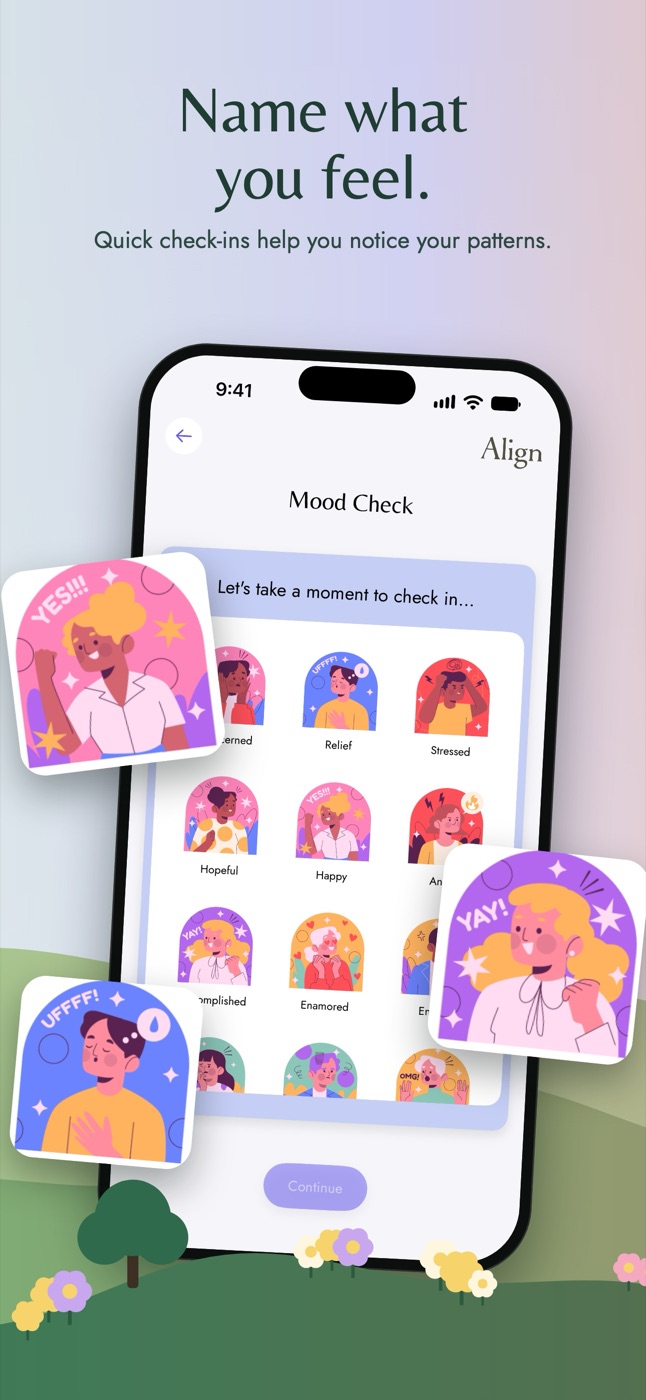
Not sure where to start? Try Align for free guided support and practices. Or try Premium for more in-depth support and personalization.
Align won’t change your family, and it isn’t therapy. But it is a place to practice coming back to yourself, living grounded, peaceful, and present a little more each day, so the skill is there when the stress and chaos comes out.
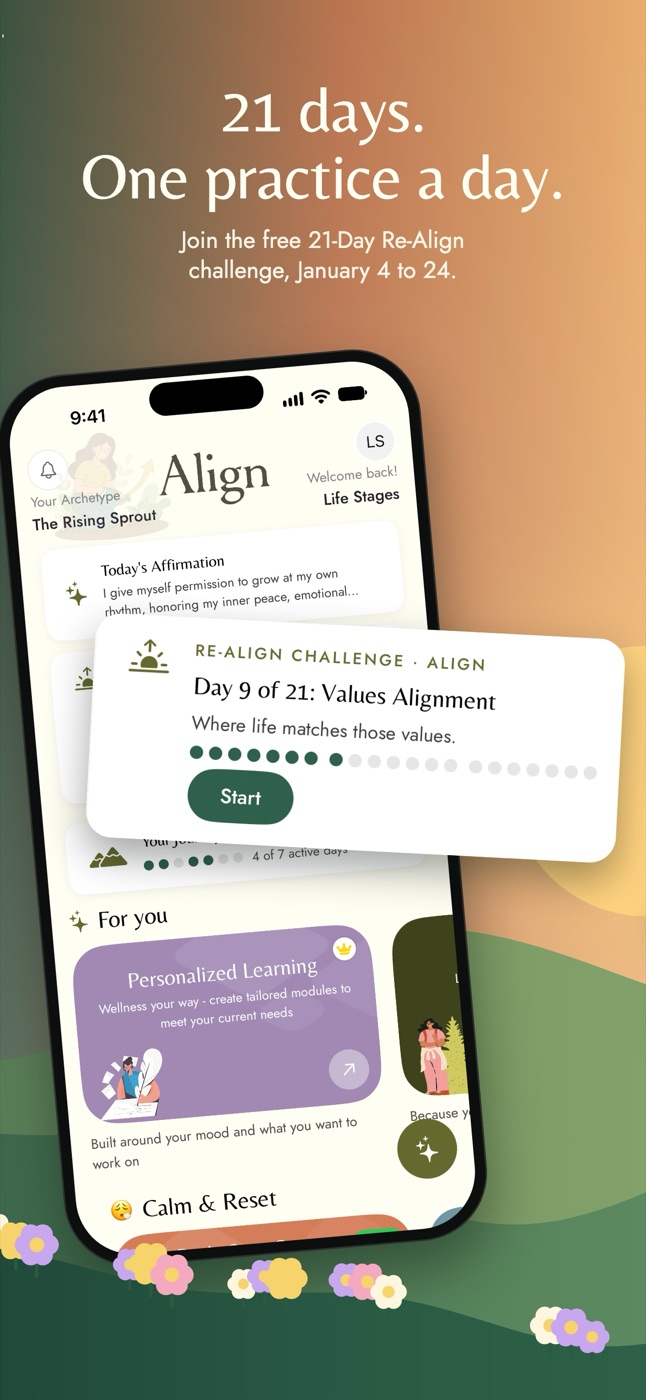
For our Re-Align season, your first month of Premium is on us—use code REALIGN27 at getaligned.lifestages.us/realign (valid through January 31, 2027). You can also join our free 21-Day Re-Align Challenge: one short practice a day, January 4 to 24, 2027. Sign up in the Align app.
Here’s to the start of a healthier, more aligned holiday season 🥂💫
The holidays can also bring up grief or loneliness that’s heavier than usual. If things feel like too much, or you’re having thoughts of harming yourself, please reach out. In the US, you can call or text 988 to reach the 988 Suicide & Crisis Lifeline, any time, day or night. A doctor or therapist can help too. Align is a wellness tool, not crisis support.
Sources
- Gollwitzer PM, Sheeran P (2006). Implementation intentions and goal achievement: A meta-analysis of effects and processes. Advances in Experimental Social Psychology 38:69-119. doi.org/10.1016/S0065-2601(06)38002-1.
- Lieberman MD, Eisenberger NI, Crockett MJ, Tom SM, Pfeifer JH, Way BM (2007). Putting feelings into words: Affect labeling disrupts amygdala activity in response to affective stimuli. Psychological Science 18(5):421-428. doi.org/10.1111/j.1467-9280.2007.01916.x.
- Fincham GW, Strauss C, Montero-Marin J, Cavanagh K (2023). Effect of breathwork on stress and mental health: A meta-analysis of randomised-controlled trials. Scientific Reports 13:432. doi.org/10.1038/s41598-022-27247-y.
- Kross E, Bruehlman-Senecal E, Park J, et al. (2014). Self-talk as a regulatory mechanism: How you do it matters. Journal of Personality and Social Psychology 106(2):304-324. doi.org/10.1037/a0035173.
- Webb TL, Miles E, Sheeran P (2012). Dealing with feeling: A meta-analysis of the effectiveness of strategies derived from the process model of emotion regulation. Psychological Bulletin 138(4):775-808. doi.org/10.1037/a0027600.
- Butler EA, Egloff B, Wilhelm FH, Smith NC, Erickson EA, Gross JJ (2003). The social consequences of expressive suppression. Emotion 3(1):48-67. doi.org/10.1037/1528-3542.3.1.48.
- Bratman GN, Hamilton JP, Hahn KS, Daily GC, Gross JJ (2015). Nature experience reduces rumination and subgenual prefrontal cortex activation. PNAS 112(28):8567-8572. doi.org/10.1073/pnas.1510459112.
- Barton J, Pretty J (2010). What is the best dose of nature and green exercise for improving mental health? A multi-study analysis. Environmental Science & Technology 44(10):3947-3955. doi.org/10.1021/es903183r.
- Hunter MR, Gillespie BW, Chen SY-P (2019). Urban nature experiences reduce stress in the context of daily life based on salivary biomarkers. Frontiers in Psychology 10:722. doi.org/10.3389/fpsyg.2019.00722.

Leave a Reply